


 Historic Jones family homestead opens to public
STORY BY JON PINE (Week of April 2, 2026)
Renovation of the modest Cracker-style clapboard house on Jungle Trail that was the longtime home of citrus grower and fruit stand owner Richard Jones and his wife, Mary, is complete. After a ribbon cutting in late March, the historic house is now open to the public three days a week, serving both as a monument to the pioneering Jones family and as a window into the history of life on the barrier island.
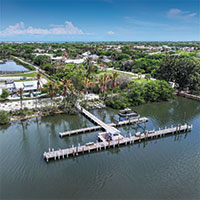
Today, visitors to the Jones Pier Interpretive Center can lounge in rocking chairs on the screened front porch overlooking the pier on the Indian River Lagoon where Jones welcomed fishermen, passing boats that stopped to purchase fresh citrus, and trading vessels that brought needed supplies to early island residents.
“The completion of the Interpretive Center brings a new element to the public experience at Jones Pier Conservation Area that provides a glimpse into the history of the Jones family, as well as life along Jungle Trail,” said Beth Powell, director of Indian River County’s Parks, Recreation and Conservation Department.
Timothy Jones, Richard’s father, built the 900-square-foot, two-bedroom house more than 100 years ago on property originally purchased by Richard’s grandfather, Seaborn Jones, in 1889. The county purchased the 16.5-acre site in 2008 for $6.75 million, with a promise to preserve its legacy and allow the Joneses to continue living there for the rest of their lives. Mary Jones died the following year, and Richard passed away in 2011.
Soon after, the county began developing plans to restore the house, which was still in good condition, and turn the site into a wildlife conservation area with a salt marsh, boardwalks and walking trails.
Built of durable Miami-Dade pine, the home withstood more than a century’s worth of tropical storms and hurricanes before succumbing in 2016 to Hurricane Matthew, a monster Cat-5 storm that just missed Vero Beach but still threw up the biggest storm surge in memory, a 10-foot wall of water that overflowed the lagoon and nearly washed out a stretch of A1A on the north island.
After the storm surge retreated, leaving the Jones house with waterlogged floors and drywall, the county revised its plans, deciding to elevate the home 5 feet on sturdy concrete piers to protect it from future flooding and to withstand the weight of visitors.
Soaked drywall was replaced, the pine flooring was restored, and a new design for the interior created that includes educational displays and exhibits, a large aquarium for native species and a nature-based educational play area for children. The bedroom walls were removed, the kitchen and bathroom updated, and a laundry room converted into an office for staff. Jalousie windows were removed from the porch, converting it to an old-fashioned screened porch, and the original wooden sash windows in the rest of the house were repaired.
“The frame of the house was basically in pretty good shape,” said job superintendent Allen Payne, who managed the renovation for Close Construction, the county’s contactor. “It survived however many hurricanes for more than 100 years and is still standing.”
Other than adding a new air conditioning system and upgrading the electrical service, the idea was to replicate the building as closely as possible to its original state, according to Wendy Swindell, Indian River County’s assistant director of parks and conservation.
“It will look remarkably like it did when the Jones family was living there,” said Swindell, who oversaw the project for the county. “We were very intent on keeping things within the spirit of that time.”
While the renovation doesn’t qualify the home for inclusion in the National Register of Historic Places, the site is considered “a contributing structure” to the Jungle Trail, which is included in the Register, Swindell said.
The house is open Tuesdays, Thursdays and Saturdays from 10 a.m. to 1 p.m. Conservation Lands Division Environmental Educator Olivia Roddenberry or another staff educator will be onsite at those times to greet visitors and answer questions, Swindell said. Eventually, a nonprofit group of volunteers will help greet and educate visitors.
Bicycles that Richard and Mary Jones used for transportation are displayed near the front entrance. Inside, there is a large television display with informational videos about the history of the site and area, including a video illustrating the progress of the renovation. There are static display boards with stories and quotes from the couple about life on Jones Pier, and a shelf with Richard Jones’ diaries, in which he meticulously recorded his day-to-day activities.
Additional displays and exhibits will be rotated in and out periodically, as well, Swindell said. “We will take the pulse of what the response is from the community to see if there is a desire for other ideas.”
The county previously renovated the small caretaker’s cottage onsite and repurposed it as a wet lab for students, and built a replica of the old fruit stand, along with a pavilion and public restrooms.
It cost about $1.3 million to design the project, elevate and renovate the house, and install the exhibits. The county received approximately $460,000 in grants from several state agencies, dropping its net cost to $840,000
Except for the two years he was away serving in the U.S. Army during World War II, Richard “Dick” Jones lived his entire life in the house. He married Mary in 1948, after a long courtship, and earned his living by farming the site, selling fruit at his farm stand, and operating the pier, where he charged people who wanted to moor their boats or fish from the wooden structure. He owned the river bottom in front of his property.
Jones also led tours of the lagoon and hired himself out as a fishing guide, providing tall tales – not always 100 percent true – to the delight of those who lent an ear. Two famous annual visitors were television newscaster Walter Cronkite and preacher Billy Graham, both of whom befriended the Joneses.
Known as Orchid Isle Trail until the 1960s, Jungle Trail was the island’s main thoroughfare along the Atlantic coast up until the modern, paved Highway A1A was built, and remains a popular byway today, a nostalgic route that leads straight back into Old Florida.
The Jones Pier Interpretive Center is located at 7770 Jungle Trail. The southern entrance to Jungle Trail is off Old Winter Beach Road, which is about 5.6 miles north of Beachland Boulevard on A1A/Jimmy Buffet Memorial Highway. The center is approximately 1 mile north on the historic shell road.
Coming from the north, visitors can turn off route 510 onto Jungle Trail and drive south for about 2.7 miles to reach the site.
Visitors can also arrive by boat and dock for free at Jones Pier.
The county presents free afternoon concerts at the site during cooler months. For more information, visit indianriver.gov and search for Jones Pier Conservation Area.